Building D1 Habits as a Track Athlete
November 20, 2026 · 7 min read
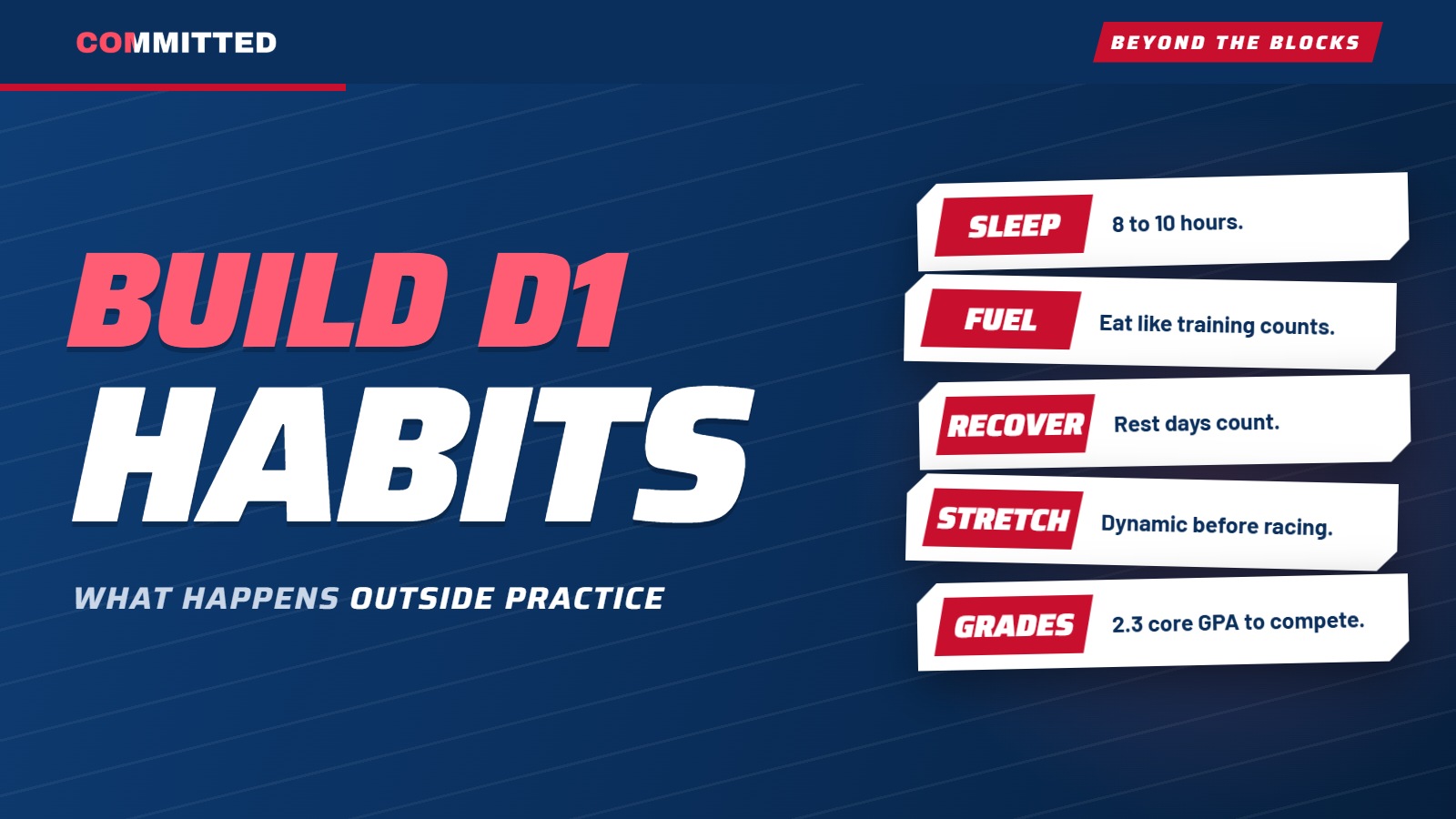
Everyone knows you have to train. Practice is the part of the job you can see, and every athlete you will ever race does it too. What separates athletes is usually the other 22 hours of the day: how you sleep, what you eat, how you recover, how you prepare your body, and how you handle school.
"D1 habits" does not mean you are headed to Division I, and none of it costs money. It means the daily routines high-level athletes build, at any level, so the work they put in at practice turns into faster times and longer throws. Start them in ninth grade and they feel normal by senior year.
Sleep: The Habit Most Athletes Skip
- Aim for 8 to 10 hours. The American Academy of Sleep Medicine recommends that teens 13 to 18 sleep 8 to 10 hours a night on a regular basis, and the American Academy of Pediatrics has endorsed that guidance.
- Short sleep and injuries show up together. In a study of 112 middle and high school athletes, those who averaged under 8 hours a night were 1.7 times as likely to have been injured as those who slept 8 or more. It was a small study at one school and it relied on survey answers, so it shows a link, not proof. It is still a good reason to take bedtime seriously.
- Count back from your alarm. If you wake at 6:30, lights out falls somewhere between 8:30 and 10:30. Pick a time and stick to it.
- Protect the night before a meet. Charge your phone across the room, and finish homework on the bus so you are not up late after you get home.
Fuel: Eat Like Training Counts
A joint position paper from the Academy of Nutrition and Dietetics, Dietitians of Canada, and the American College of Sports Medicine says that performance and recovery are helped by well-chosen nutrition. You do not need anything fancy.
- Eat enough. The American Academy of Pediatrics warns that eating too many or too few calories can contribute to fatigue, injuries, illness, poor performance, and slow recovery. Cutting food to get lighter tends to backfire. The International Olympic Committee's 2023 statement on low energy availability lists a weaker response to training, slower recovery, and more injury and illness among the results.
- Eat before you train. About 3 to 4 hours before, the AAP suggests a meal that is mostly carbohydrates with a moderate amount of protein, and low in fat and fiber so your stomach stays settled.
- Eat after you train. Within 30 to 60 minutes, refuel with carbohydrates and protein. The AAP's example is chocolate milk. A sandwich or yogurt with fruit works too.
- Spread your protein out. The position paper puts most athletes' needs at 1.2 to 2.0 grams of protein per kilogram of body weight a day. For a 150-pound athlete that is roughly 80 to 135 grams, spread across the day, and food can cover it.
- Keep drinks simple. For workouts under an hour, water is enough. Sports drinks are for long or very hot sessions. The AAP does not recommend energy drinks and says no supplement turns an average athlete into a superstar. The basics do the work.
- Ask about iron. The position paper says female athletes may need more iron, and that distance runners are among the athletes at greatest risk of low iron. Ask your doctor about screening at your next checkup, and do not start supplements on your own.
If food becomes stressful, if you are tired all the time, getting hurt or sick often, or missing periods, tell a parent, your coach, or a doctor. The position paper recommends that athletes see a registered dietitian for a personalized plan.
Recovery: Where the Training Sticks
Practice is the stress. Your body gets faster while it recovers from it. Protect that time.
- Take your rest days. The AAP advises 1 to 2 rest days a week and 2 to 3 months off from your sport over the year, which can be split into one-month blocks. Its rule of thumb is no more hours of training a week than your age.
- Make easy days easy. If every day is hard, you never absorb the hard ones.
- Spend five minutes with a foam roller. A 2019 review of 21 studies found small benefits. Rolling before sprinting slightly improved sprint performance (about 0.7 percent) and flexibility (about 4 percent), and rolling after hard sessions slightly reduced soreness (about 6 percent). It is worth doing, but it will not make up for missing sleep or food.
- Report pain that lingers. Tell your coach early. Running through it turns a week of rest into a season.
- Know the burnout signs. Feeling worn out in body or mind, losing the fun, and wanting to quit are signals to talk to someone. For more on this, read Indoor Season: The Good, The Bad & The Ugly.
Warm Up and Stretch at the Right Time
Stretching is not wasted effort. It just has a right time.
- Before practice and races, go dynamic. A 2011 review recommends easy aerobic running, then large, flowing movements like leg swings, skips, and high knees, then event-specific drills. A 2023 analysis of 35 studies found that dynamic stretching improved sprint time while static stretching made it slightly worse. Its best explosive results came from about 7 to 10 minutes of dynamic work.
- Save the long holds for later. The same 2011 review says static stretching in a separate session gives range-of-motion benefits. Do it after practice or at night, not right before you race.
- Stretch for movement, not speed. A 2024 review found that regular static stretching did not meaningfully improve sprinting or jumping. Use it to keep your hips, hamstrings, calves, and ankles moving well, and spend 5 to 10 minutes on it a day.
Grades: The Part That Decides Whether You Can Compete
To compete at a Division I school you have to qualify academically, and qualifying starts in ninth grade.
- The Division I minimums. The NCAA requires 16 approved core courses and a core-course GPA of at least 2.3. Ten of those courses, seven of them in English, math, or science, must be finished before the start of senior year. Division II asks for a 2.2. These are minimums to be eligible. Each college sets its own admission standards, and NCAA certification is not the same as being admitted.
- Meet your counselor as a freshman. Ask for your school's list of NCAA-approved core courses and take from it.
- Check your grades every grading period. Do not wait for the report card.
- Do homework right after practice, before your phone. Make it a fixed time, the same every day.
- Talk to teachers before you miss class for a meet, and ask for help in the second week, not the tenth. Spring is the busiest stretch, when meets, finals, and big exams all land together.
- Plan on finishing. The NCAA reports a 90 percent Graduation Success Rate for Division I athletes. A track career ends, and a degree does not.
On Committed, you can add your GPA to your profile and submit evidence so it shows as Verified. Coaches can filter for a minimum GPA, and that filter counts Verified GPAs only.
Make It a Daily Checklist
Do not try to change everything this week. Pick one habit, do it for two weeks, then add another.
- In bed on time for 8 to 10 hours
- Three real meals, plus a snack with carbohydrates and protein
- Water through the day
- A dynamic warm-up before practice
- Five minutes of rolling or stretching after
- Homework done before the phone
- Every result logged with its link
Whichever level you are aiming for, Division I, II, III, NAIA, or junior college, these habits keep you healthy, eligible, and improving, which is what every program needs from a recruit.
This post is general information, not medical or nutrition advice. Talk to your doctor, a registered dietitian, and your coach about what is right for you. NCAA rules change, so check the current requirements.
Habits are easier to keep when your progress is easy to see. Create your Committed profile, add each result with its link, and add your GPA with proof so it shows as Verified. Parents, you can create a parent account to help. Wondering what to say once a coach is looking? Read How to Wow College Coaches. Not sure when to start? Read When Should You Start the Recruiting Process for Track and Field?.
Sources
- Recommended Amount of Sleep for Pediatric Populations (American Academy of Sleep Medicine consensus statement, 2016)
- Chronic lack of sleep is associated with increased sports injuries in adolescent athletes (Milewski et al., Journal of Pediatric Orthopaedics, 2014)
- Nutrition and Athletic Performance (Academy of Nutrition and Dietetics, Dietitians of Canada, and the American College of Sports Medicine, 2016)
- Sports Nutrition for Busy Families and Busy Lifestyles (American Academy of Pediatrics, HealthyChildren.org)
- 2023 IOC consensus statement on Relative Energy Deficiency in Sport (REDs) (International Olympic Committee)
- Too Much, Too Soon: Overtraining (American Academy of Pediatrics, HealthyChildren.org)
- A Meta-Analysis of the Effects of Foam Rolling on Performance and Recovery (Wiewelhove et al., Frontiers in Physiology, 2019)
- A review of the acute effects of static and dynamic stretching on performance (Behm and Chaouachi, European Journal of Applied Physiology, 2011)
- A systematic review and net meta-analysis of the effects of different warm-up methods on the acute effects of lower limb explosive strength (BMC Sports Science, Medicine and Rehabilitation, 2023)
- Effects of chronic static stretching interventions on jumping and sprinting performance (Frontiers in Physiology, 2024)
- Division I initial-eligibility requirements (NCAA)
- 2026-27 Guide for the College-Bound Student-Athlete (NCAA)
- NCAA graduation rates remain high (NCAA, November 19, 2025)