Preparing for Your First Indoor Track Meet
November 29, 2026 · 6 min read
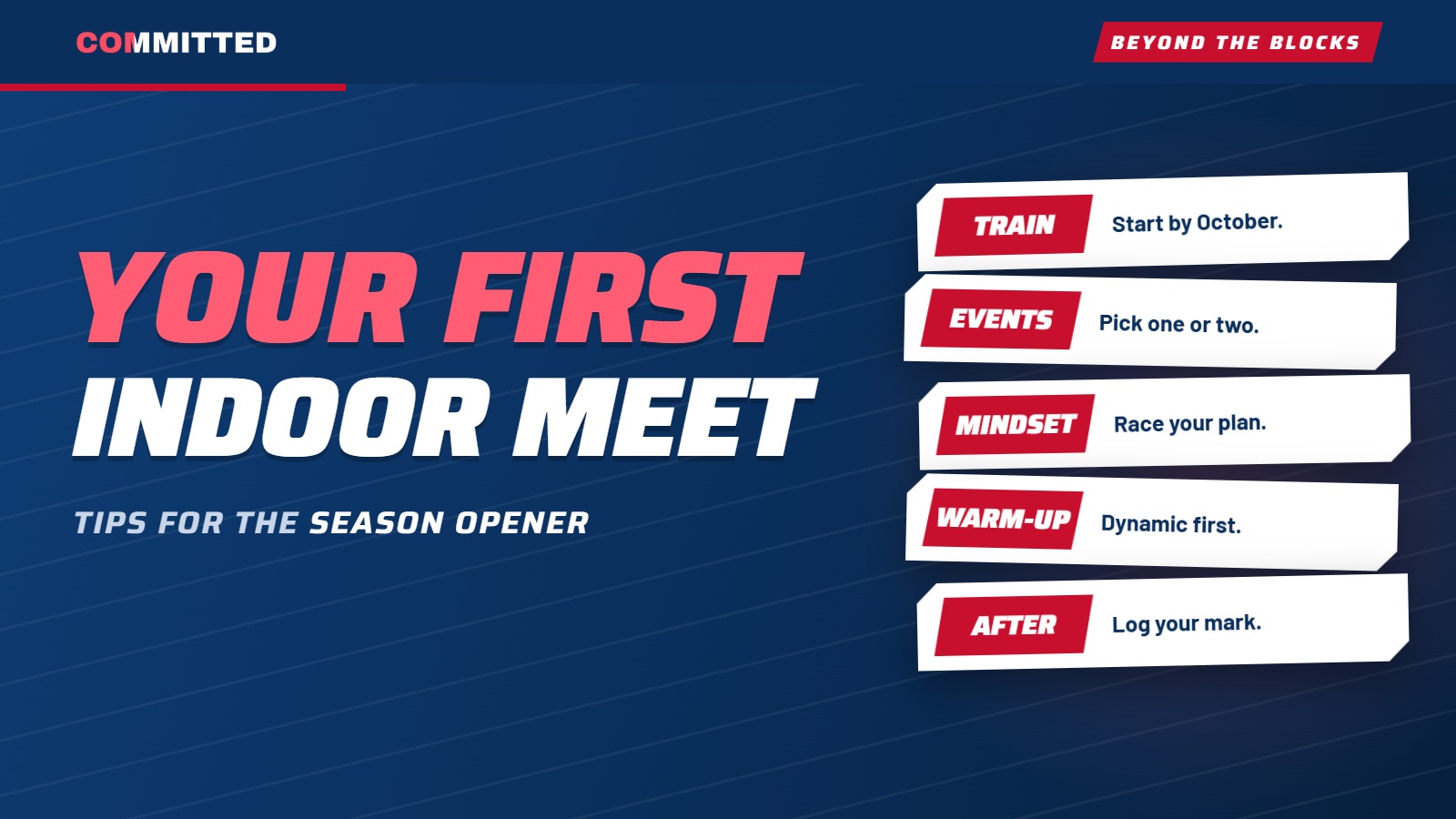
Your first indoor meet is a big moment, and it is also just one race on a long calendar. For many athletes it has been three to six months since your last competition. Your legs may be ready, but your racing brain is probably rusty. This post covers how to get ready, what to expect, and how to handle the mental side, so you can start the season on the right foot.
You Should Already Be Training
The first meet is not where your season starts. Your training should have begun by October at the latest, so that by race day you have weeks of steady work behind you: a base, some speed, and practice at the parts of your event that feel strange after a long break, like starts, handoffs, and tight turns.
A quick readiness check:
- You have trained consistently since October, not in one big burst.
- You have practiced your start or approach in workouts, not just your running.
- You have done at least one session near race pace in the last couple of weeks.
- Nothing has hurt for more than a few days in a row.
If you are behind, tell your coach now. Run the meet as a hard workout, race one short event, and treat the result as a starting point. Racing all out on top of a late start is how athletes get hurt. Rest days are part of training too. The American Academy of Pediatrics advises 1 to 2 rest days every week.
Pick One or Two Events
Resist the urge to enter every event you could run. The first meet is not the one to try them all.
- It is a baseline. You are finding out where you are, not proving everything at once.
- Indoor meets are long. Check-in, heats, and waiting add up, and every extra race adds fatigue when your body has not raced in months.
- A tired third or fourth race tells you very little. A slow time in your last event does not mean you are slow.
- Your best event deserves your best effort.
Ask your coach to set your events. A good rule of thumb is your main event plus, at most, one more that fits it, such as a sprinter running the 60 meters and adding the 200. Save the heavier schedule for later meets, when you are sharper.
Get Your Head Right After a Long Break
You have not raced in months, so expect a little rust. Starts may feel unfamiliar, your pacing may be off, and your nerves will probably be higher than you remember. That is normal.
- Treat the first race as information. Your job is to learn what felt good and what to fix, not to run your best time of the year.
- Do not compare it to your outdoor PRs. Indoor and outdoor marks are not apples to apples, and a first race is rarely your best. For more on this, read Indoor Season: The Good, The Bad & The Ugly.
- Turn nerves into excitement. In a set of studies on karaoke singing, public speaking, and math, people who told themselves "I am excited" out loud performed better than people who tried to calm down. Those studies were not about track, but the trick costs nothing to try. Your heart is racing either way, so give that feeling a useful name.
- Build a pre-race routine. A position statement from Exercise and Sports Science Australia lists pre-performance routines among the strategies that help athletes perform under pressure. Use the same warm-up, the same few breaths, and the same cue word every time you step to the line.
- Set process goals. Pick two things you control, like driving out of the blocks and running the turn tight, plus one simple outcome, like running a time you can build from.
- Practice pressure before you need it. The same statement says training with pressure prepares athletes for it. Time trials and mock races in practice make race day feel familiar.
If the race goes badly, it is one race. Talk to your coach, find the one thing to fix, and move on to the next one.
Know What Indoor Is Like
Indoor racing is different from the outdoor season you remember. The National Federation of State High School Associations says indoor tracks are typically 200 meters, half the length of an outdoor track, with tighter turns, and some are banked.
- Lane assignments matter. In the sprints, some lanes help on the curves, so check your heat and lane with the clerk and ask your coach how to run it.
- Lap counting matters. A 1,500-meter race is seven and a half laps on a 200-meter track. Know your lap count and listen for the lap counter.
- Throwers and jumpers have changes too. Field events are set up with modifications and stricter boundaries because space is limited, and some states use the weight throw as an indoor event.
- The turns come fast. Practice running the curve in your warm-up strides so your first real turn is not a surprise.
The Week of the Meet
- Keep it light and sharp. Follow your coach's plan, and do not try a new workout, new shoes, or a new food.
- Sleep. The American Academy of Sleep Medicine recommends 8 to 10 hours a night for teens 13 to 18. Protect the night before the meet most of all.
- Eat regular meals. About 3 to 4 hours before you race, the American Academy of Pediatrics suggests a meal that is mostly carbohydrates with a moderate amount of protein, and low in fat and fiber.
- Pack the night before. Spikes or flats (check with your coach and the meet information about what the facility allows), uniform, warm-ups, water, snacks, your phone charger, and anything you need for check-in.
Meet Day
- Arrive early. Find check-in, the warm-up area, and where you report before your event. Indoor meets often run behind, so be ready for waiting.
- Warm up in order. A 2011 review recommends easy aerobic running first, then large flowing movements like leg swings, skips, and high knees, then event-specific drills. Save the long static stretches for after you race.
- Stay warm between events. Keep your warm-ups on and keep moving.
- Keep fuel simple. For events under an hour, water is enough. Eat light between events.
- Refuel afterward. Within 30 to 60 minutes after you finish, eat carbohydrates and protein. The American Academy of Pediatrics gives chocolate milk as an example.
After the Race
- Write it down. Your time, what worked, and one thing to fix.
- Talk to your coach within a day. Compare notes and set the next goal.
- Log your result. On Committed, a mark with a results link shows as Verified, and indoor and outdoor marks are logged separately.
- Keep it in perspective. A first-meet time sets your baseline for the season. It is a start, not a verdict.
Your First Meet Checklist
- Training since October, with a readiness check done
- One or two events, picked with your coach
- A pre-race routine and two process goals
- Lane, heat, and lap count known
- Bag packed and arrival time set
- Sleep, a meal 3 to 4 hours before, and water
- A plan to write down your result and log your mark
This post is general information, not medical advice or a training plan. Talk to your coach about what is right for you.
Ready to log your first indoor mark? Create your Committed profile, add each result with its link, and start the conversation with college coaches. Parents, you can create a parent account to help. Want more habits that carry you through the season? Read Building D1 Habits as a Track Athlete.
Sources
- Understanding the basics of indoor track and field (National Federation of State High School Associations, February 2025)
- Get excited: reappraising pre-performance anxiety as excitement (Brooks, Journal of Experimental Psychology: General, 2014)
- Performance Under Pressure in Sport: A Position Statement from Exercise and Sports Science Australia (Sports Medicine, 2026)
- Burnout in Young Athletes: How to Keep the Fun in Sports (American Academy of Pediatrics, HealthyChildren.org)
- Recommended Amount of Sleep for Pediatric Populations (American Academy of Sleep Medicine consensus statement, 2016)
- Sports Nutrition for Busy Families and Busy Lifestyles (American Academy of Pediatrics, HealthyChildren.org)
- A review of the acute effects of static and dynamic stretching on performance (Behm and Chaouachi, European Journal of Applied Physiology, 2011)